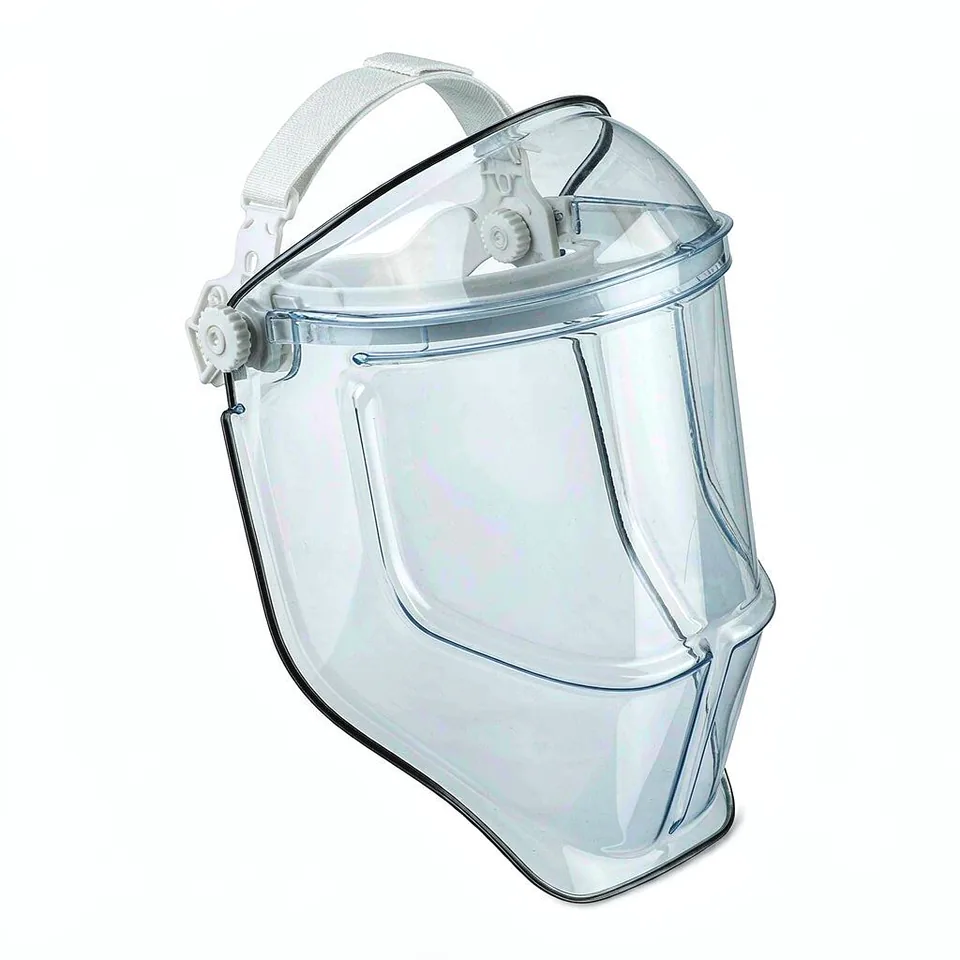
Spectacles, goggles and face shields are all eye protection and they close different gaps. The safety glasses vs goggles vs face shield decision is a question about gaps, not about price, and the usual mistake is picking the most comfortable of the three rather than the one that covers the direction the hazard arrives from.
Spectacles
Spectacles with side arms cover the front and the side. They are the default for flying particles: grinding dust, chipping, cutting, drilling, general site work. Their weakness is the gap above and below the lens and around the nose. That gap is why they are a poor choice for fine dust and the wrong choice for liquid.
Wraparound lenses close more of the side than a flat lens with a side shield, and they also reduce the tendency to look around the lens instead of through it.
Goggles
Goggles seal against the face. They are the right answer for fine dust, mist, aerosol and any task where the contaminant behaves like a cloud rather than a projectile: mixing powders, spraying, pressure washing, working under a vehicle, emptying sacks.
Indirect vent goggles let air move without letting splash in, which is the compromise most workshops want. Fully sealed goggles are for chemical splash and immersion, and they are hotter and fog more, which is the price of the seal.
Face shields
A shield protects the whole face, which is the point when the hazard is a spray of liquid, a burst of hot material, or large chips from a high-speed tool. It is not a substitute for primary eyewear: a shield stands away from the face and debris can come up underneath. The correct combination is almost always a face shield over spectacles or goggles, not a shield alone.
Prescription wearers
Where workers wear prescription glasses, over glasses safety goggles or spectacles keep the prescription in place and remove the reason people take eye protection off. Over-glasses goggles are bulkier than over-glasses spectacles and seal better; over-glasses spectacles are lighter and are what a prescription wearer will actually keep on for eight hours.
Fogging decides compliance
The best-matched eyewear that fogs in ten minutes ends up on a bench. Hot, humid work and a dust mask that sends exhaled air up behind the lens are the two conditions that cause it. Where either applies, the product needs a coating and enough airflow to stay clear — the mechanism and its failure modes are covered in the anti-fog note.
Matching by task
Grinding and cutting metal: spectacles, or goggles if the dust is fine. Chemical handling and decanting: sealed goggles with a face shield. Pressure washing: goggles plus a shield. Woodworking: spectacles with a brow guard. Laboratory: goggles for the shift, not spectacles. Chainsaw and brush cutting: a shield with a mesh or polycarbonate visor and spectacles underneath.
The three references we keep are IS-E145 (wraparound spectacle), IS-E120 (indirect-vent goggle) and IS-E310 (ratchet face shield).
Written by our product desk
These notes describe what matters in the product and what we will put in writing. If your situation does not match the general case, send it to us — a specific question gets a specific answer, in writing.
More notes
All notesPrevious note: Bump caps and helmets: where the line actually sits
Next note: Anti-fog coatings: how they work and why they stop