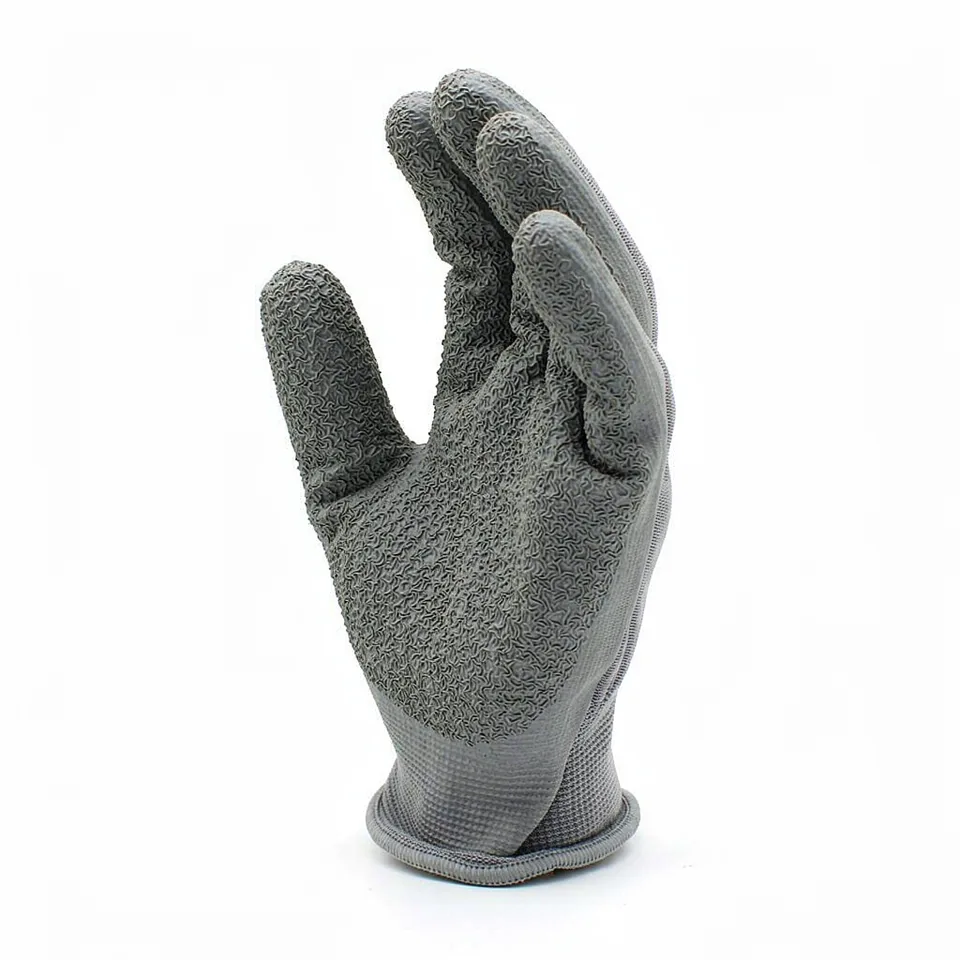
A palm coating looks like a finish on a catalogue page. In the hand it is the part of the glove that touches the object, and it decides grip, feel and how long the pair survives. Two gloves knitted on the same liner, one coated in nitrile foam, one in PU, behave like two different products — which is why the choice between nitrile foam vs PU coated gloves is decided by the task rather than the price per pair.
What the coating is actually doing
Across the palm coated work gloves in this range, the coating does three jobs, in this order. It gives grip on a surface the bare liner cannot hold. It keeps oil, coolant and dust out of the yarn. And it wears instead of the liner, so the glove dies at the palm rather than at the thumb web. Everything else — the colour, the pattern, the word “breathable” — is secondary to those three.
Nitrile foam
Nitrile foam is a spongy layer with open cells, applied to the palm and fingers. Nitrile coated glove grip is at its best on light oil, coolant, and damp or slightly greasy parts, where a smooth coating slides. Because it is soft it also absorbs a little of the shock when handling small parts all shift, which is why it is popular on assembly lines and in maintenance.
Its limits are feel and dust. Foam is thicker than a flat dip and duller through the fingertips, so on clean, dry precision work it removes the sensitivity the task needs. It also picks up fine abrasive dust in the open cells, and a foam glove full of grit wears through faster than the same liner with a smooth coating.
PU
PU is thin, dense and smooth. It gives the best tactile feedback of the common palm coatings, which is why PU assembly gloves dominate light assembly, electronics, picking and the handling of small dry components. A PU glove lets you feel whether a screw has seated.
Its limit is oil. Prolonged contact with mineral oil softens the coating and it starts to break down, usually at the knuckle and the thumb web first. A PU glove that felt excellent in week one becomes a complaint in week three on an oily bench. PU is also the coating most often sold as “breathable”; it is thinner, not breathable in any meaningful sense.
Heavier dips
Where the workpiece is heavier, the edges rougher or the oil heavier, the coating needs to be thicker and harder. A flat or sandy nitrile dip trades dexterity for abrasion life, and it is the sensible answer for sheet metal offcuts, oily castings and general workshop work where foam would be shredded in a week.
The liner under the coating
Coating performance is capped by the liner. A polyester knit with a light foam is the industrial workhorse: cheap, durable, adequate feel. A nylon liner is softer and better for fine work. Cotton is cheaper, hotter, and holds moisture against the skin. The knit fineness matters as much as the yarn — a finer knit gives a thinner glove, more dexterity and less abrasion life.
How to choose without a sample room
Three sentences describe most requirements: what the hand holds (material, weight, whether there are edges), what is on the part (dry, oil, coolant, water), and how long a pair is expected to last. Coating, liner and knit follow from those three answers far more reliably than from a photograph of the old glove.
The two references we keep for this choice are IS-G210, a nitrile foam palm on a polyester knit, and IS-G315, a thin PU palm for dry assembly and picking.
Written by our product desk
These notes describe what matters in the product and what we will put in writing. If your situation does not match the general case, send it to us — a specific question gets a specific answer, in writing.
More notes
All notesPrevious note: Safety helmet specification: shell, suspension and cost
Next note: 13, 15 or 18 gauge: what a glove knit number changes