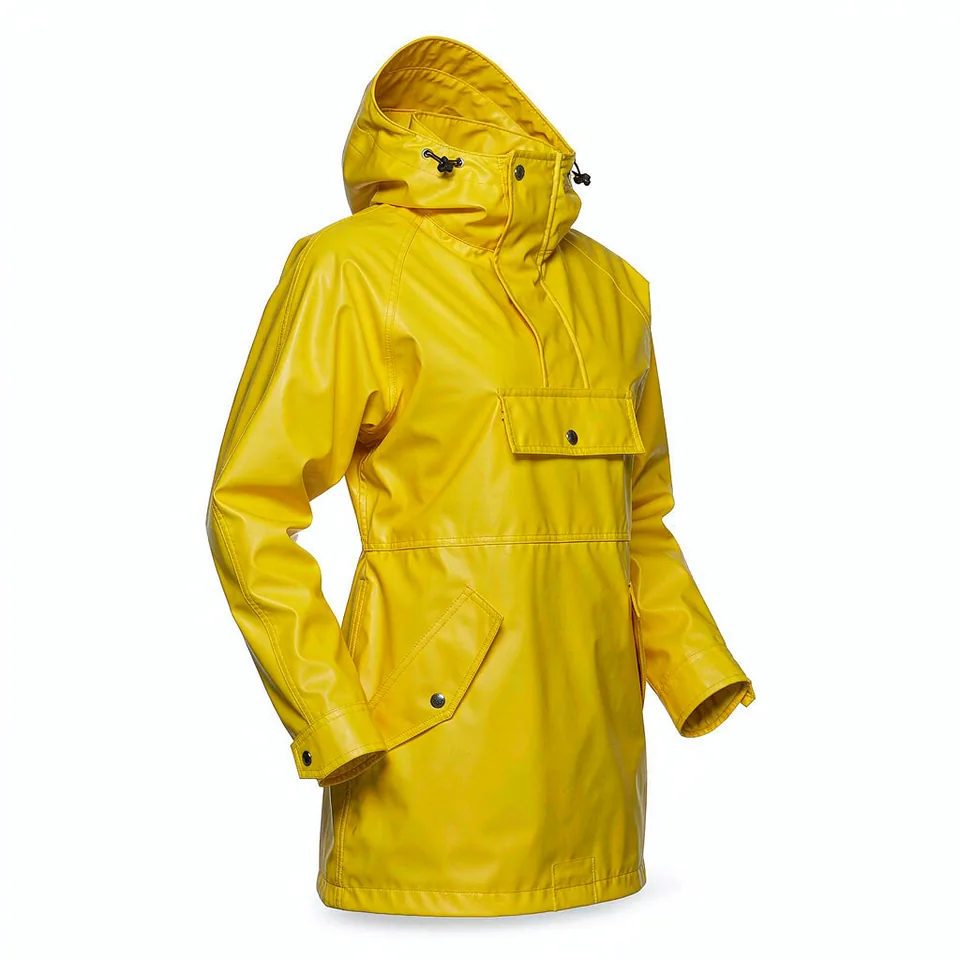
Every PVC rain jacket in a catalogue looks waterproof, and most of them are, until water finds the places where the garment is joined. Fabric is the easy part. PVC rain jacket seams, zips, cuffs and shoulders are where a rain jacket earns or loses its price.
The base fabric
PVC coated polyester rainwear is the common industrial construction: a woven polyester base for strength with PVC on one or both faces. Heavier coating on a heavier base gives a garment that resists abrasion and stays rigid in wind; lighter versions pack small, cost less, and tear at stress points when pulled over a harness or a tool belt. Nylon base is lighter and softer and less abrasion-resistant, which matters if the wearer kneels or carries timber.
Seams
A stitched seam leaves a row of needle holes. Welded seam rainwear closes the join with heat or high frequency; the alternative is stitching the seam and taping over the stitching. A stitched seam with no tape survives drizzle and fails in a downpour, or the first time the wearer kneels in water. On a quotation, “taped seams” and “welded seams” are different products at different prices, and the difference only appears in use.
Where it fails first
Shoulders. Highest water load, most abrasion from carried loads and straps. Crotch and seat, on trousers: repeated flexing works taped seams loose. The zip. A flap over the zip is what keeps water out; an exposed zip is a channel. Cuffs and hem. Water runs down the sleeve and wicks into the glove or the boot. Fold lines. PVC stored folded for months cracks along the fold, which is why the first jacket out of a container is often the one that leaks.
Breathability, honestly
PVC does not breathe. In warm rain the wearer gets wet from the inside, and that is a property of the material rather than a defect in the garment. The practical answers are underarm ventilation, a loose cut, and layering that does not trap moisture underneath. In a hot climate this matters more than the waterproof construction, because a garment that is unbearable is a garment that gets left in the cab.
Hi-vis versions
On a hi-vis rain suit, the reflective tape has to bond to a smooth, low-energy PVC surface, which is harder than bonding to textile. Tape that lifts at the corners within the first month is a bonding problem, and it usually appears at the shoulder and the back panel first — the two places with the most flex and the most handling.
Cold weather
PVC stiffens as the temperature drops. A jacket that is comfortable at 15°C becomes a board at −5°C and the folds crack. For cold stores and winter road work, the question is not whether the garment is waterproof but what it does at the temperature it will actually be worn at.
What to send with an enquiry
Climate, the task (standing in rain, kneeling, working overhead), whether hi-vis is required, how the garment is stored between seasons, and whether it goes over a harness. Those five answers decide the weight, the seam construction and the cut.
References for this are IS-V720 (PVC rain jacket with hood) and IS-T220 (hi-vis rain jacket and trouser set).
Written by our product desk
These notes describe what matters in the product and what we will put in writing. If your situation does not match the general case, send it to us — a specific question gets a specific answer, in writing.